
Don’t Let Screens Steal Their Curiosity. Join our mail club!
Replace mindless screen time with a real letter and meaningful learning they’ll actually enjoy. Studies link excess screen time to lower attention spans. Bring back curiosity with hands-on stories. See how below.
Maya´s Family Guide
Make each letter more than something they read. Make it something they remember.
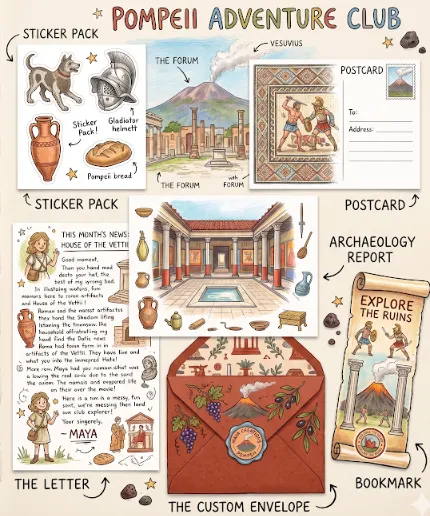
Every month, Maya arrives with a new adventure from the past.
But the real magic doesn't have to end when the letter is finished.
With a few simple ideas, you can turn Maya's letters into conversations, discoveries, family traditions, and screen-free moments your child will actually look forward to.
You don't need to be a history expert. You don't need hours of preparation.
Just follow your child's curiosity.
Start Here — Make the Letter an Event
When Maya's letter arrives, resist the temptation to turn it into a lesson.
Instead, make it feel special.
Let your child open the envelope themselves. Read it together, let them read it aloud, or simply ask them to tell you what happened.
Then try one simple question:
“What was the most interesting thing you learned?”
That's it.
You don't need to quiz them.
You don't need to make sure they remember every historical detail. The goal is to make your child think:
“I want to know more.”
That's where curiosity begins.
The 5-Minute Curiosity Habit
You can make Maya's arrival a small monthly family tradition.
Maybe you read the letter together after dinner.
Maybe you open it on a Saturday morning.
Maybe your child finds it waiting at their place at the breakfast table. There is no right way.
What matters is creating a moment when everyone puts down what they're doing and enters Maya's world together.
Try this simple ritual:
1. Open
Let your child open Maya's envelope.
2. Read
Read the letter together—or let your child read it to you.
3. Wonder
Ask one question about what you just discovered.
4. Explore
If your child wants to know more, follow the rabbit hole together.
5. Remember
At the end, ask:
“If you could visit this time and place, what would you want to see?”
Five minutes can be enough.
Questions That Get Kids Thinking
One of the best things you can do after reading Maya's letter is...
ask a question and wait.
Instead of immediately explaining something, try: “Why do you think they did that?”
“What would you have done?”
“Would you have liked living there?”
“What surprised you?”
“What do you think happened next?”
“Why do you think Maya felt that way?”
There isn't always a correct answer.
That's the point.
History becomes much more interesting when children are allowed to wonder, imagine, question, and form their own ideas.
Turn the Letter Into Family Time
Whenever your child finishes a letter, try asking:
“What would you have done?”
It's a remarkably simple question—but it turns your child from a reader into a participant. If Maya is meeting a historical figure:
“Would you have trusted them?”
If Maya is living somewhere unfamiliar:
“Would you have wanted to live there?”
If Maya witnesses an important event:
“What would you have done if you were there?”
If Maya encounters a problem:
“How would you have solved it?”
There is no worksheet required.
Go Beyond the Letter — Optional Activities
You don't have to know all the answers. In fact, sometimes saying:
“I don't know. Let's find out.”
is even better.
You are showing your child that learning isn't something that ends when you leave school. It's something curious people do together.
Try making Maya's adventures a family conversation:
At dinner
“What do you think people ate where Maya was?”
In the car
“Would you have wanted to travel like Maya?”
Before bed
“What was the strangest thing Maya saw?”
On a weekend
“Let's see if we can find out what happened next.”
Small conversations can become meaningful family memories.
Screen-Free History Adventures
Maya's letters are designed to give children something exciting to do away from a screen.
You can take that idea even further.
After reading each letter, choose one screen-free activity connected to the story.
Become an Archaeologist
Hide a few small objects around the house.
Give your child clues and let them investigate.
Make a Historical Meal
Find a simple food connected to the place or period Maya visited and make it together.
Build It
Use cardboard, LEGO, blocks, paper, or whatever you have available to recreate something from the letter.
Dress for the Era
Let your child create an outfit inspired by the historical period using things around the house.
Draw a Historical Scene
Ask:
“What do you think Maya saw when she arrived?”
Then let your child draw it.
Play a Historical Game
Invent a simple game inspired by something Maya encountered.
Take a Time-Travel Walk
Go outside and imagine you have just arrived in Maya's historical world. What would be different?
What would you notice first?
A Family Time-Travel Ritual
Once a month, choose one question from Maya's adventure and investigate it together.
For example:
“How did people travel without cars?”
“What did children do for fun?”
“How did people communicate?”
“What did houses look like?”
“What did people eat?”
Spend 10–20 minutes finding out.
Then ask:
“Would you rather live then or now?”
This simple comparison helps children understand history by connecting it to something they already know:
their own lives.
A Simple Monthly Family Challenge
Here are some easy activities you can use with almost any Maya letter.
1. Time-Travel Drawing
Draw yourself arriving in Maya's time. What do you see?
What are you wearing?
Who do you meet?
2. Historical Postcard
Design a postcard from Maya's location.
Include:
• The place
• The date
• Something Maya saw • One interesting fact
3. Then & Now
Fold a piece of paper in half. On one side draw:
THEN
On the other:
NOW
Compare food, houses, transportation, clothing, school, entertainment, or communication.
4. What Would You Pack?
Imagine you are traveling to the same time and place as Maya. You can only bring 5 things.
What would you choose?
Why?
5. Historical Detective
Pick one object from the letter. Ask your child to investigate: What was it used for?
Who used it?
How was it made?
What do we use instead today?
6. Make a Museum
Choose 3–5 objects connected to Maya's adventure.
Your child creates a mini museum at home.
They can make labels explaining what each object is and why it matters.
7. Become the Storyteller
Ask your child to retell Maya's adventure—but from the perspective of someone else she met. What did they see?
What did they think Maya was doing?
What happened after Maya left?
8. Time Traveler's Journal
Give your child a notebook and call it:
Maya's Time Traveler Journal
After every letter, they can record:
Where did Maya go?
When was she there?
What did she discover?
What surprised me?
What do I want to know next?
Most Importantly..
Don't worry about doing everything.
You don't need to complete every activity.
You don't need to turn every letter into a project. You don't need to test your child.
And you definitely don't need to be a history expert.
The letter is already doing the hard work.
Your job is simply to make space for curiosity. Read together.
Ask questions.
Listen.
Wonder.
Laugh.
Look things up when your child wants to know more.
And every once in a while, put everything else aside and take a few minutes to travel through time together.
Because years from now, your child may not remember every historical fact Maya taught them.
But they may remember sitting beside you, opening an envelope, and discovering another world together.
That's the real adventure.
Give your child something meaningful to look forward to each month. Our story-driven letters turn screen time into exciting adventures that inspire focus, imagination, and a lifelong love of learning — one letter at a time.
Quick Links
Useful Links
© 2026 Maya Letters. All Rights Reserved.
Give your child something meaningful to look forward to each month. Our story-driven letters turn screen time into exciting adventures that inspire focus, imagination, and a lifelong love of learning — one letter at a time.
Quick Links
Useful Links
Contact Us


